
Self-learning revenue agents: every customer makes the next one smarter
Every static tool you buy peaks on day seven. Every self-learning agent compounds. The next decade of sales tech will be decided by which side of that line you are on.

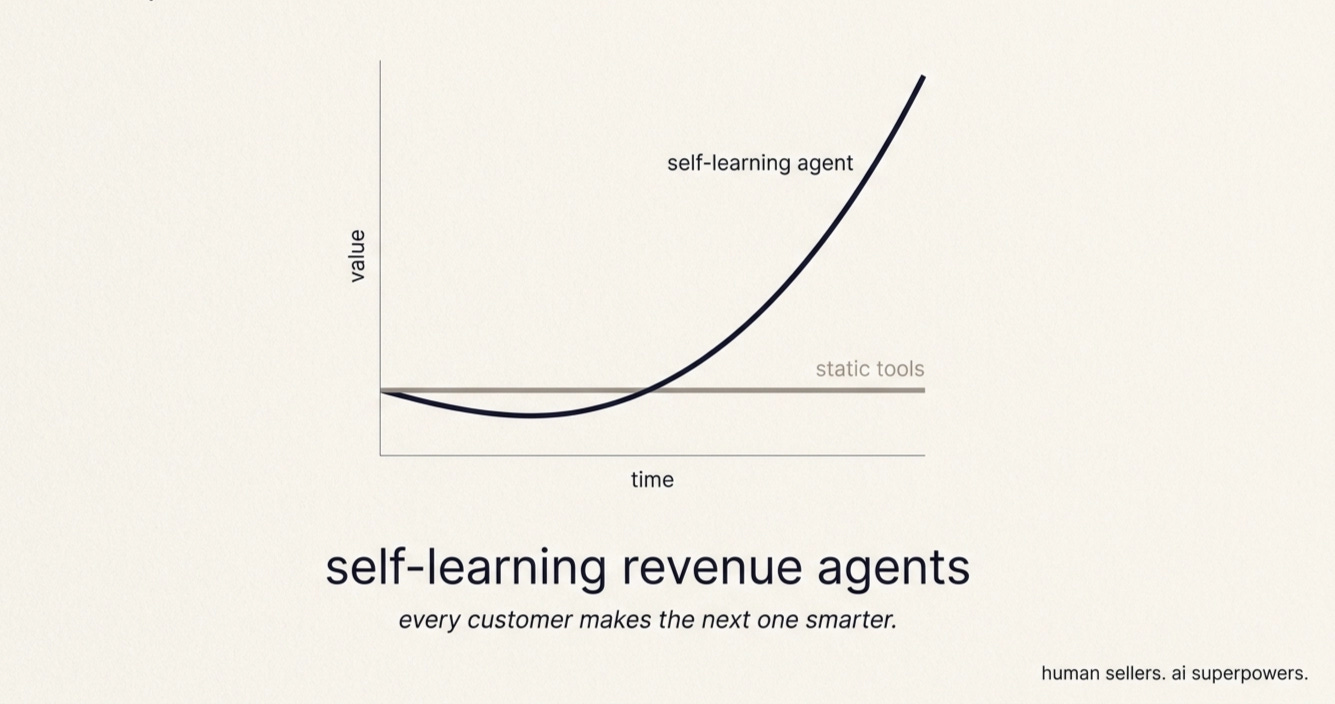
The day a tool peaks is the day you stop winning with it
Most sales tools are sold as if they will keep getting better. They will not.
A data provider ships you a list. The list is freshest the moment it is delivered. From hour one, it ages.
A sales engagement platform ships you a sequence. The sequence is sharpest the day you write it. Every reply, every reschedule, every buyer signal that follows is information the tool never folds back in.
A generic AI writer ships you a draft. The draft sounds like every other draft that model has written for every other founder in every other industry. It does not learn your voice. It does not learn your customer’s voice. It does not learn that on Tuesday afternoons your champion only replies on WhatsApp.
This is the volume trap dressed up in 2026 clothing. More data, more sequences, more drafts. None of it remembers anything.
The cost of static tools, made specific
Research is consistent: sellers spend roughly 23 to 40 percent of their week actually selling. The rest goes to CRM entry, prep, follow-up, reporting, and tool switching. 78 percent of sellers missed quota in 2025.
The usual explanation is that reps need more discipline, more enablement, more coaching. That is the wrong frame.
The real reason is that the stack underneath them does not learn. It cannot.
The CRM remembers fields. It does not remember why the deal slipped.
The data provider remembers titles. It does not remember that this VP Sales already churned out of two competitors.
The engagement platform remembers cadences. It does not remember that your best customer never replied to the first email, only to the third one with a specific phrase in the subject line.
The AI writer remembers the prompt you typed this morning. It forgets it by tomorrow.
Every hour your rep spends inside a stack that does not learn is an hour they have to be the memory. They are the integration layer. They are the context graph. They are the reason every other tool sort of works.
That is the real $14,400 per rep per year cost of non-selling. It is not just time. It is the cognitive tax of being the only learning system in a stack of static ones.
What changes when the agent itself learns
A self-learning revenue agent is not a smarter chatbot. It is a different category of system.
The shift is simple to state and hard to build.
A static tool delivers an output. A self-learning agent runs three loops in the background, every day, on every account, on every interaction, and gets sharper as your team sells.
Loop one: signal precision improves with every reply
Every outbound signal SalesDuo fires has a downstream outcome. Replied. Ignored. Meeting booked. Champion changed. Deal closed.
A static signals tool fires the signal and forgets.
A self-learning agent watches what happened next. It learns that for your ICP, a Series A funding signal converts. A Series C funding signal does not. It learns that for your product, a new VP Sales hire is worth ten new website visits. It learns that the words your buyers actually respond to are not the words on your website.
Week one, the signals look generic. Week ten, the signals look like they were picked by someone who has been selling your product for a year.
No other category of tool gets sharper at this. Data providers cannot, because they do not see your replies. Engagement platforms cannot, because they do not weigh signals. AI SDRs cannot, because their loop is reply rate, not revenue.
Loop two: the context graph gets denser with every interaction
The context graph is the part of SalesDuo that most resembles a living memory.
Every email, every WhatsApp thread, every LinkedIn DM, every meeting note, every CRM update is resolved into a graph of organisations, people, products, deals, signals, interactions, and decisions.
The first week, the graph is thin. It knows what you told it during onboarding plus what it pulled from HubSpot.
By week four, it knows which of your accounts has three internal champions and which has none. It knows which deal has gone dark on email but is alive on WhatsApp. It knows that the CFO at one account replies in 20 minutes and the CFO at another replies in 20 days.
By week twelve, the graph is something a human cannot hold in their head. A rep walks into a meeting and the agent surfaces the three things that actually matter from a year of mixed-channel history, not the last note that someone bothered to type into HubSpot.
A static CRM is a filing cabinet. A self-learning context graph is a colleague who never forgets.
Loop three: style and judgment converge on your voice
The third loop is the one most people underestimate, because it sounds soft.
It is not.
Every draft a self-learning agent writes for you is reviewed, edited, sent, or scrapped by a human. Every one of those decisions is feedback. Over time the agent learns that you start with an observation, not a pitch. That you never use the word “synergy”. That you sign off differently with founders than with VPs of Sales. That when you forward a case study, you always strip the logo.
A generic AI writer does none of this. It produces something average for everyone. Average is the ceiling.
A self-learning agent does the opposite. It produces something that sounds like you, and the gap between its draft and your final widens, then narrows, then closes.
This is the difference between a tool that helps you write faster and an agent that learns to write the way your customers respond to.
Why this is the moat, not a feature
Self-learning is not a feature to bullet-point on a comparison page. It is the structural advantage that determines which AI sales platforms exist in five years and which ones get bought for parts.
Three reasons.
First, every customer makes the next customer’s experience better. Not in the sense of shared data, which is a privacy disaster. In the sense of better ontology, better signal weighting, better defaults, better edge case handling. The product on day 365 is not the product on day seven.
Second, the moat compounds inside a single workspace. A rep at month six is operating on a context graph and a personal style model that no competitor can replicate by sending an SDR or a discount. Switching costs are not built by long contracts. They are built by accumulated memory.
Third, this is the only category of sales AI where the math points up and to the right over time. Static tools degrade. Self-learning agents appreciate.
This is the same shift that happened in search, in recommendations, in fraud detection. The systems that learned compounded. The systems that delivered a single output got commoditised.
Sales is next.
The honest part
We are early. SalesDuo has been live in production with a small number of customers. The three loops above are running today on real workspaces, but the curve from “useful on week one” to “unfair advantage on month six” is still being walked, not claimed.
The reason to write this now is not to declare victory. It is to plant the flag.
The next 20 years of sales will not be won by whoever ships the most features in 2026. It will be won by whoever builds the system that gets sharper as the team sells, and keeps getting sharper while everyone else’s tool peaks on day seven.
What this means if you are evaluating tools this quarter
If you are a founder or a Head of Sales looking at the AI sales market right now, the questions to ask are not about features.
They are about loops.
Does this tool learn from my replies, or just send messages?
Does this tool build a memory of my accounts that survives a rep leaving?
Does this tool sound more like my best rep over time, or more like every other customer’s tool?
On day 365, will this product be measurably better at my specific motion than it was on day seven?
A static tool fails all four. A self-learning revenue agent is the only category that passes them on purpose.
That is the difference. That is the moat. That is the bet.
Human sellers. AI superpowers. The agent gets sharper as your team sells.